

Come over. Tell me Everything.
musings on the friendship breakup.

There are women who arrive without warning. Not exactly romances, more like platonic muses.
Yeah, exactly. Something older than the word friendship. More cellular than simple syntax.
A certain kind of female friendship bypasses performance entirely and settles directly into the architecture of your becoming and changes you for better or for worse. The friendship begins before you understand yourself, which means it becomes stitched into the mythology of who you think you are. One version of you cannot be recalled without the other standing nearby holding a cigarette, your most guarded secret, a grocery receipt, a baby, a funeral dress, a stiff drink.
People talk constantly about first loves. Rarely about first witnesses; as in TRULY and deeply being understood by somebody. Woman to Woman.
But I think being witnessed by another woman over the course of your life may be one of the most intimate experiences available to us here. A friend sees you in so many different lights and shadows.
She knew you when you were twenty something and insufferable, eating peaches from a truck over the sink in an apartment with no air conditioning.
She knew you during the year you mistook melancholy for intelligence and dated it few times, too. She knew you before the babies came, before the marriage,
before the nervous breakdown, before the healing language, before the medication, before the total reckoning that is becoming an adult woman. Not a girl.
And because she remembers, those selves continue existing somewhere.
That’s the terrifying beauty of long-term female friendship: it becomes a fucking external hard drive for your identity.
Which is why losing it feels less like heartbreak and more like complete cellular breakdown, your own body and mind attacking itself.
I think literature has always understood this better than culture has. Romantic love gets the orchestras, but female friendship gets the real forensic attention.
The feverish devotion between girls in My Brilliant Friend. The intense loyalty of Sula. The drifting psychic closeness of The Bell Jar.
Even history itself is crowded with women preserving one another through correspondence, collapse, and war:
Virginia Woolf and Vita Sackville-West writing to each other with something that can only be described as intimacy.
Women have always kept each other alive psychologically. We can give each other a knowing glance, a nurturing back rub, and it all feels like it’s going to be okay for a moment.
Civilization itself may partially rest upon one exhausted woman saying to another: Come over. Tell me fucking everything.
And yet friendship breakups remain strangely unserious in public discourse. I’ve yet to read a piece of literature or watch a film that properly shows the unmistakable ache of a friendship ending.
There are no established mourning rituals. No language quite grand enough for the devastation. If your husband leaves, people understand the scale immediately.
If your closest friend disappears from your life, people expect you to recover quietly, almost invisibly. She wasn’t worth it anyway. Yes, yes the fuck she was.
As though losing the person who carried your history inside her body should feel casual in any way!!! It never does and it never will as long as we are here on this plane.
Esther, A SHARED LIFE
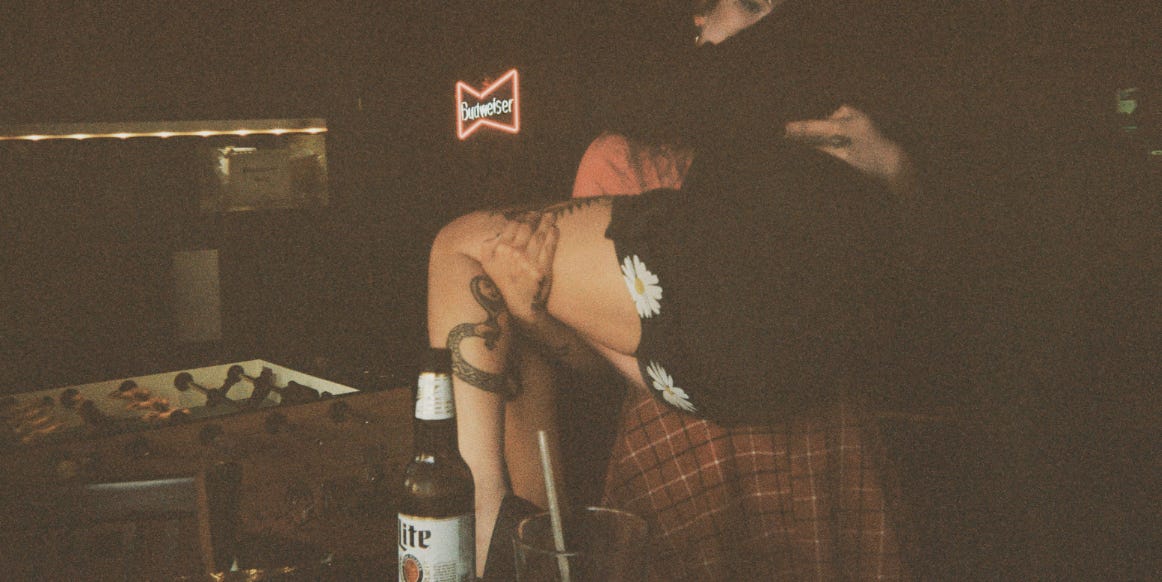
I met Esther on a music video set in Nashville after I graduated film school. She was doing hair; I was taking behind the scenes Polaroid and 35mm shots. I remember noticing her immediately — instinctively, physically. She had one of the most beautiful faces I’d ever seen, full lips, big doe eyes, and her hair was buzzed with just a little bit of growth coming out. Later that day I would learn she had just shaved it two weeks before; her now ex-boyfriend had cheated on her with a woman who had lice, and her being a hairstylist that had to be around people to work immediately just shaved it. She looked like someone who had already survived several lives, and indeed she had. There was something magnetic about her from the beginning in the way some women carry their contradictions openly. She could make someone laugh while discussing the worst thing that had ever happened to them. She moved through rooms like she belonged nowhere and everywhere simultaneously. It was love at first sight.
The first day we hung out, we spent eighteen straight hours together. Eighteen.
By the end of the night, it felt less like meeting someone and more like remembering them from a past life. We drove around Nashville shooting film photographs of each other and getting into trouble until the city started turning silver-blue with morning. We drank too much, smoked too much, laughed ourselves nauseous, told each other entire life stories with the strange recklessness women sometimes reserve only for each other. The kind of emotional immediacy that would seem unhinged in any other context somehow felt completely kismet and natural with her.
There are friendships that develop gradually and sensibly, maybe someone in your friend group introduces you; Then there are the ones get on like a house fire, warm and roaring.
For the next decade, we were nearly inseparable. People would think it was weird when one was without the other. Entire eras of my twenties and early thirties blur together with her standing somewhere in the frame. backstage in venues, sitting cross-legged on dirty apartment floors at four in the morning, helping me shoot photographs, chain-smoking outside parties, crying over men who deserved significantly less ceremony than we gave them. It was actually a joke that she ended up crying every year on her birthday, no matter the stops I pulled out. So, we made it a tradition that I took a photo of her in tears every year, all of them hung up on her fridge in tribute. Even the last birthday I spent with her, I rented out a local theater that was about 100 years old (I knew a guy who worked there), and he said I could pick a movie for her and I to watch in there alone. We dropped acid, I picked Secretary (2002). Our favorite movie. We watched James Spader spank the shit out of Maggie Gyllenhaal high as fuck on psychedelics. She definitely cried, but this time it was out of happiness and sheer gratitude. Nashville itself felt stitched together by our friendship then. I can hardly remember that city without remembering her, nor would I want to.
We watched films together constantly. Her showing me her hilarious favorites and me showing her my pretentious ones. Fully submerged, not a cellphone in fucking sight. We actually had a rule that if we had to take a call or text the movie had to be paused, full stop. Whole days would disappear into her apartment, blue half translucent curtains drawn, the room flickering with subtitles and cigarette smoke and the low hum of something French and mid-century unraveling on a Criterion menu she had access to through a sugar daddy who, in retrospect, functioned mostly as a funding source for our shared education in cinematic excess. We used the shit out of that mans Criterion subscription. I have my own now but damn, I really appreciate him in retrospect. We treated that subscription like a private archive we had been entrusted with. I had seen a lot of movies she had not, and she was always down to clown. Clown being, watch anything I told her to, as long as there was cocaine, cheap red wine in coffee cups, and full-bodied cigarettes to boot. Boyfriends came and went, but our movie marathons were a dreamy constant in our lives.
Godard, Varda, Truffaut, obscure New Wave films with women staring directly into the camera like they were accusing us of something. We would pause constantly, not because we were confused, but because we wanted to talk over everything. To interrupt the film with ourselves. We were always interrupting reality with ourselves back then. God, that was fun.
There was a particular obsession with French New Wave that felt, at the time, like intellectual seriousness, but was probably just permission for chaos. We would watch movies during the day and go out to party at night, always doing our makeup on the floor by a mirror with the dim light of movies still whirring in the background. We were always happy to look such a mess. Lipstick teeth, runs in our tights, and unexplained bruises absolutely everywhere. Now, I know that it was likely iron deficiency. We would watch characters drift through Paris with no moral resolution and feel personally validated by it. Yes, we were failing at adulthood pretty miserably, but we were participating in an older, more stylish kind of disobedience according to the films.
And then there was Daisies (1966). It’s a Czechoslovak New Wave film known for its feminist comedy and just all-around hedonistic chaos. I had forgot about the film for a few years since graduating, but something in me remembered it one faithful night while hanging out with Esther. I was like “HOLY FUCK DUDE, I have a movie we need to watch. These chicks are basically us.” The girls are drifting through a collapsing world, deciding that if everything is spoiled anyway, they might as well spoil it more beautifully. Esther and I felt that way about our lives, too.
Two girls in a kind of anarchic fever dream, destroying order just to see what would happen, laughing through the collapse of everything around them. Hedonistic brats, basically, if you wanted to be uncharitable. Or something closer to feral innocence, if you wanted to be generous. We joked constantly that it was about us, because it really was. We were the two most bratty, lazy women I knew. Only doing things for the plot and if they felt good.
We were detached from the rest of the world’s expectations.
We also had this habit of treating movies like instruction manuals for emotional life, which sounds pretentious, but was actually just two exhausted young women trying to translate themselves through other people’s images.
In reality, we were building a shared mythology out of art which I think is oddly wholesome.
What I loved about our friendship was that it allowed both of us to remain strange. There was no pressure to become more digestible around each other. I was more comfortable around Esther than I had been around any boyfriend or friend I’d ever had. We were like one; taking care of each other when we were sick and celebrating each other’s every win. Big or microscopic. We encouraged each other’s intensity, and always had each other’s back, even when we were being dumb bitches. We romanticized things probably beyond reason. I remember we went out dancing one night and dressed up beyond recognition. It was the most fun I’d ever had, I felt like the star of a romantic comedy and a child at the playground laughing until I was sick. We were absolutely insufferable sometimes, really. But we were alive in a way I miss now and then, and I know I’ll never be there again.
And the complicated thing is: I don’t think either of us became worse versions of ourselves when our lives diverged. Just different ones.
Looking back, I think we mistook intensity for permanence. We would both tell each other to SHUT THE FUCK UP if the other joked about dying or not being friends one day. It was too haunted a thought to bear.
Things began changing when I met my husband and eventually became a mother. Not immediately. She was happy to be Auntie for a year or two. There wasn’t some dramatic split-screen moment where one life replaced the other. For a while, we tried hard to bridge the distance between our evolving worlds. But motherhood altered the architecture of my life completely. My days became different. Slower, sober, and strangely sacred. Domesticity, which I once feared would annihilate me creatively, instead revealed parts of myself I had never met before and ultimately allowed me to become a more complete version of my SELF.
Meanwhile Esther started doing a goth club residency and club promoting in a completely different city, and our nights began to look radically different from each other’s. I was waking up at dawn with babies while she was coming home at dawn with boys in their 20’s. Neither reality was more valid. That’s the aching tragedy of it. There was no moral failure in the divergence. No big bad wolf. No betrayal dramatic enough to justify the grief.
Just two women walking slowly out of sync with each other.
I think people underestimate how disorienting it can be when someone who helped author one version of your identity no longer fully recognizes the person you’re becoming. It’s terrifying in the moment.
There’s grief in being misunderstood, but there’s also grief in outgrowing mutual mythology, because if you two are not keeping it alive, then who will?
Part of me worried she saw motherhood as a disappearance, or that she thought I turned into a lame ass normie. Like I had crossed over into some irreversible terrain of normalcy.
And maybe part of me saw her continued nightlife and chaos as a refusal to be alongside me and really see me for the woman I was becoming.
We never fully said these things aloud, which is probably why they calcified silently between us over time.
The cruelty of long friendship endings. The silence accumulates before anybody notices they’re building a wall.
And still, when I think of her now, I don’t think first about the ending. I think about the girl who I spent my twenties with. I think about my muse. I think about film negatives of her drying in bathrooms. I think about her laughing so hard she couldn’t breathe. I think about who we allowed each other to be during those years, we needed each other. There are versions of me that only exist because Esther once looked at me and said: I love you. Keep going.
This was so moving and really touched me. Thank you for this beautiful piece 🫶
brilliant...